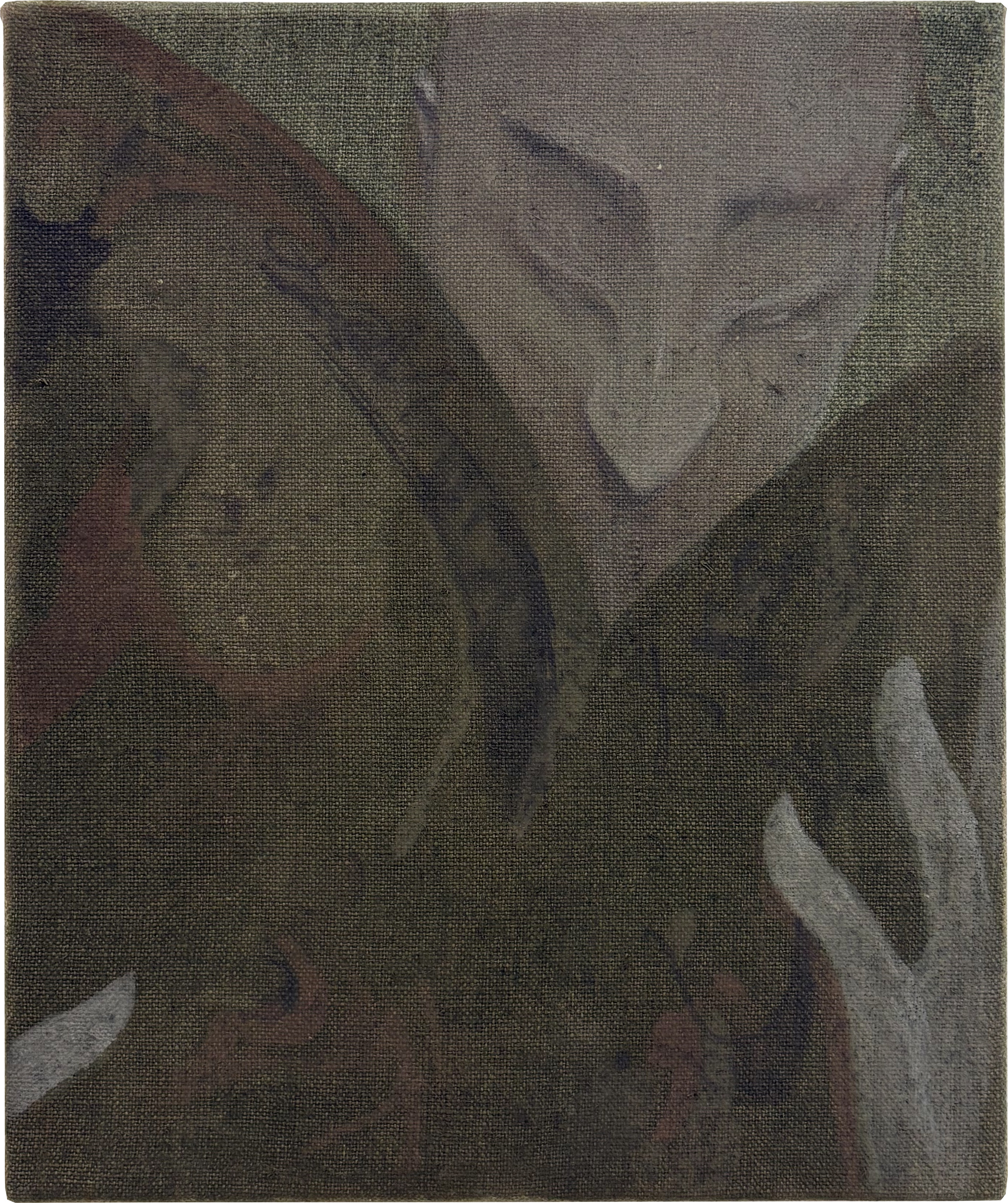
As part of Ole Goldt first solo exhibition with the gallery in 2026, I am pleased to share an interview with the artist.
Ole Goldt is a german painter (born in 1997) and his painting is particularly remarkable for its freedom. Indeed, the arrangement of colours, shapes and figures – everything is considered equally important by German painter. These are tools available for composition. The result is a painting with a a new approach to reading it and this freedom is reflected to each of his pictorial compositions. The artist explores in different size formats, first through drawing, then on canvas. For instance, the painter distances himself from the relationship between subject and background as well as from linear perspective. Sometimes, everything mingle on a single plan, like a collage. Furthermore, the characters are no longer reduced only to a purely narrative role; they are sometimes relegated to the edge of the canvas, truncated, becoming elements at his disposal that allow his paintings to find the right balance. This sometimes results in disjointed characters, creating movement and a dynamic specific to each work. While his smaller formats allow for a more linear reading, we encounter characters whose representations serve the composition and dynamics that the artist wished to instil. On the contrary, for his larger formats, our gaze never stops on a single element; it delights in losing itself in these vast compositions, where each time a new element gradually reveals itself and surprises us.
Ole Goldt is a german painter (born in 1997) and his painting is particularly remarkable for its freedom. Indeed, the arrangement of colours, shapes and figures – everything is considered equally important by German painter. These are tools available for composition. The result is a painting with a a new approach to reading it and this freedom is reflected to each of his pictorial compositions. The artist explores in different size formats, first through drawing, then on canvas. For instance, the painter distances himself from the relationship between subject and background as well as from linear perspective. Sometimes, everything mingle on a single plan, like a collage. Furthermore, the characters are no longer reduced only to a purely narrative role; they are sometimes relegated to the edge of the canvas, truncated, becoming elements at his disposal that allow his paintings to find the right balance. This sometimes results in disjointed characters, creating movement and a dynamic specific to each work. While his smaller formats allow for a more linear reading, we encounter characters whose representations serve the composition and dynamics that the artist wished to instil. On the contrary, for his larger formats, our gaze never stops on a single element; it delights in losing itself in these vast compositions, where each time a new element gradually reveals itself and surprises us.
With Ole Goldt, we talked about his practice, his approach to painting, his creative process and his main sources of inspiration.
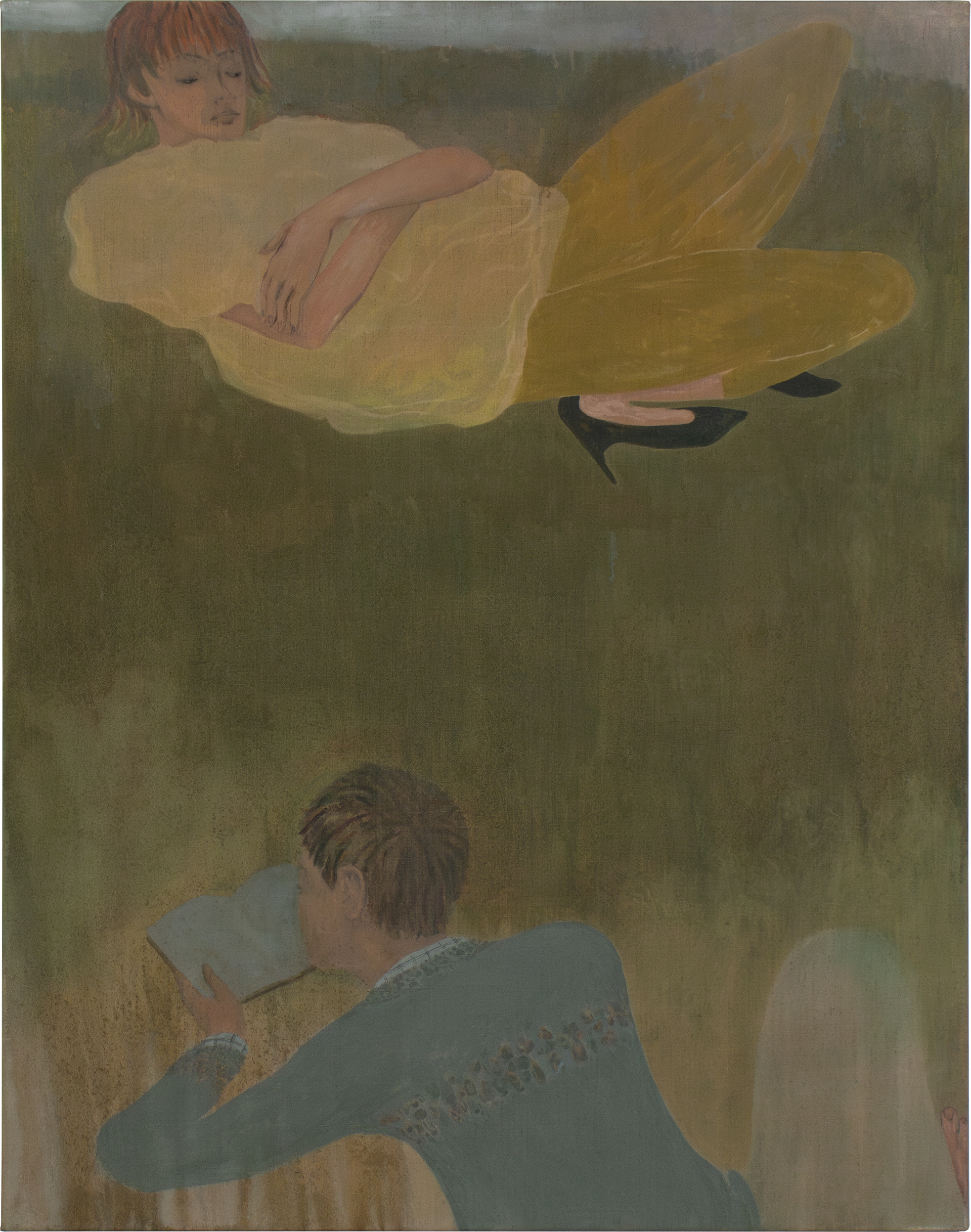
Die Lektüre, 2023, Oil on linen, 140 x 110 cm
"For me, painting is the most interesting visual art form, because you get incredible freedom in the way you compose."
Ole Goldt
Ole Goldt
Elsa Meunier- Can you introduce yourself? (Short bio, career path, what determined your choice to devote yourself to your artistic practice).
Ole Goldt- I was born in 1997 and grew up in a small town in northern Germany, with no one in my family having any background in arts. Still somehow I was always very interested in visual media, mainly drawing and painting, I remember painting figures on the walls of my childhood room or sitting at my table drawing until late in the night.
When I started attending art school, I really focused on painting. Spending a lot of time in the studio and experimenting with different sizes and techniques helped me to understand a lot about my own work and what I want from it.
When I started attending art school, I really focused on painting. Spending a lot of time in the studio and experimenting with different sizes and techniques helped me to understand a lot about my own work and what I want from it.
After my graduation in 2025 I now moved into my very first own studio with two friends.
E.M- Several large formats juxtapose different scenes and narratives on a single plane. I am thinking, for example, of the following works titled Bankasa ; Gostak. The reading of the artworks no longer follows a classical perspective but, on the contrary, seems to redefine the very act of reading a work. Several perspectives intermingle and the very idea of subject/background does not exist. Everything blends together, is reversed, and the figures are often relegated to the corners of the paintings, truncated people appearing at the edge of the canvas, while the center of the canvas often gives free rein to color, shapes and motifs colored. There is great compositional freedom. Can you tell us about this work and your approach?
O.G- For me, painting is the most interesting visual art form, because you get incredible freedom in the way you compose. Not only with color, but also in the way you arrange forms and figures. With everything I paint, I always want to create some kind of tension, sometimes to confuse the viewer, sometimes to surprise. I found that the most effective way to do that, is to juxtapose different themes, or to put something in contrast to each other. Breaking narratives and perspectives by adding figures next to empty forms, or just adding straight lines next to gestural strokes.
I see the painting as a whole, where small ornaments are as important as figures. Placing them on the edge of the work often frames some kind of emptiness. That is something that interests me a lot in traditional Chinese painting and currently I am also very interested in japanese woodcuts, which typically display collage-like cut-out ornaments. These elements always find ways into my own work.
E.M- Other works, on the contrary, offer a more traditional interpretation with a single subject against a neutral background. I notice that you explore and bring together these two approaches in series that offer different visions and interpretations of the same subject. I think to Die Lektüre series for instance. What interests you about working in series ?
O.G- Some works come across best in a specific size, and sometimes I like to take a single situation or form out of that image and work on it on a smaller size. With these works its interesting to me, how you need to think about the composition and color in a completely different way and how they stand on their own, even though I took the same figure from another work.
Die Lektüre is a perfect example of emptiness surrounded by two figures. For me, that’s the theme the work is based on. With the smaller works, showing the figure at the bottom, the focus is more on the actual figure. It is not better or worse, it is just different. Switching between these different ideas of composition also helps me with working, sometimes I need a break from one work, so I just start a second one.
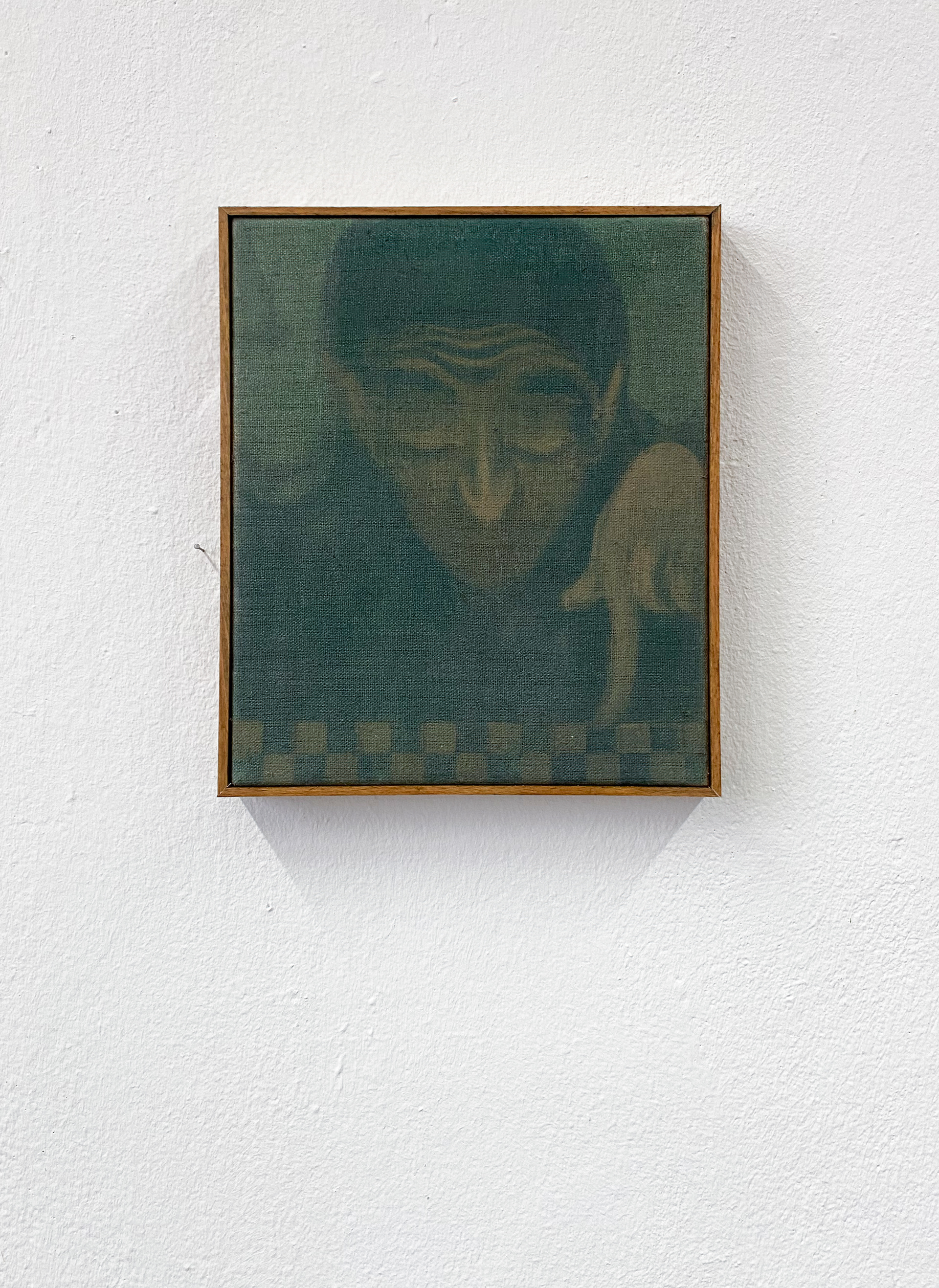
Untitled (Check)
E.M- You also create small formats such as the one titled Untitled Check where this time the surface is dedicated to a single figure on a neutral background, to the portrait genre. Are these small formats independent from your practice on large formats, or do you consider these works to be complementary?
O.G- Different formats offer different possibilities, that’s why I would say most of them are independent. Works like Untitled (Check) would only work in that size.
I remember a friend of mine saying, that in order to do great big paintings, you first need to start small. But sometimes I feel like its the exact opposite and its often the small formats, that are the most challenging.
I remember a friend of mine saying, that in order to do great big paintings, you first need to start small. But sometimes I feel like its the exact opposite and its often the small formats, that are the most challenging.
Some works, like the ones out of series, work well in the surroundings of others, still it is important to me, that they work on their own as well.
E.M- The characters on the canvas are depicted with a great freedom too. They seem sometimes disarticulated : we can see a long finger in the work Untitled Check, a long leg with a pointed foot in the work titled Bankasa. Could you speak about these characters and their depictions?
O.G- Characters are incredibly versatile. When I decide to put them into a painting, it is not so much about a story or personality, for me its more a tool that I use, like ornaments or other forms. Ornaments create this feeling, it is almost like they have some kind of expression. Using faces or bodies amplifies this a lot, it is as if there’s a blurry transition between characters and ornaments in my work. You can see that, when figures blend into other forms and become one. With placing the figures on the edge of the work, I use them as some kind of frame. Letting them walk out or into the frame also breaks with traditional compositorial ideas.
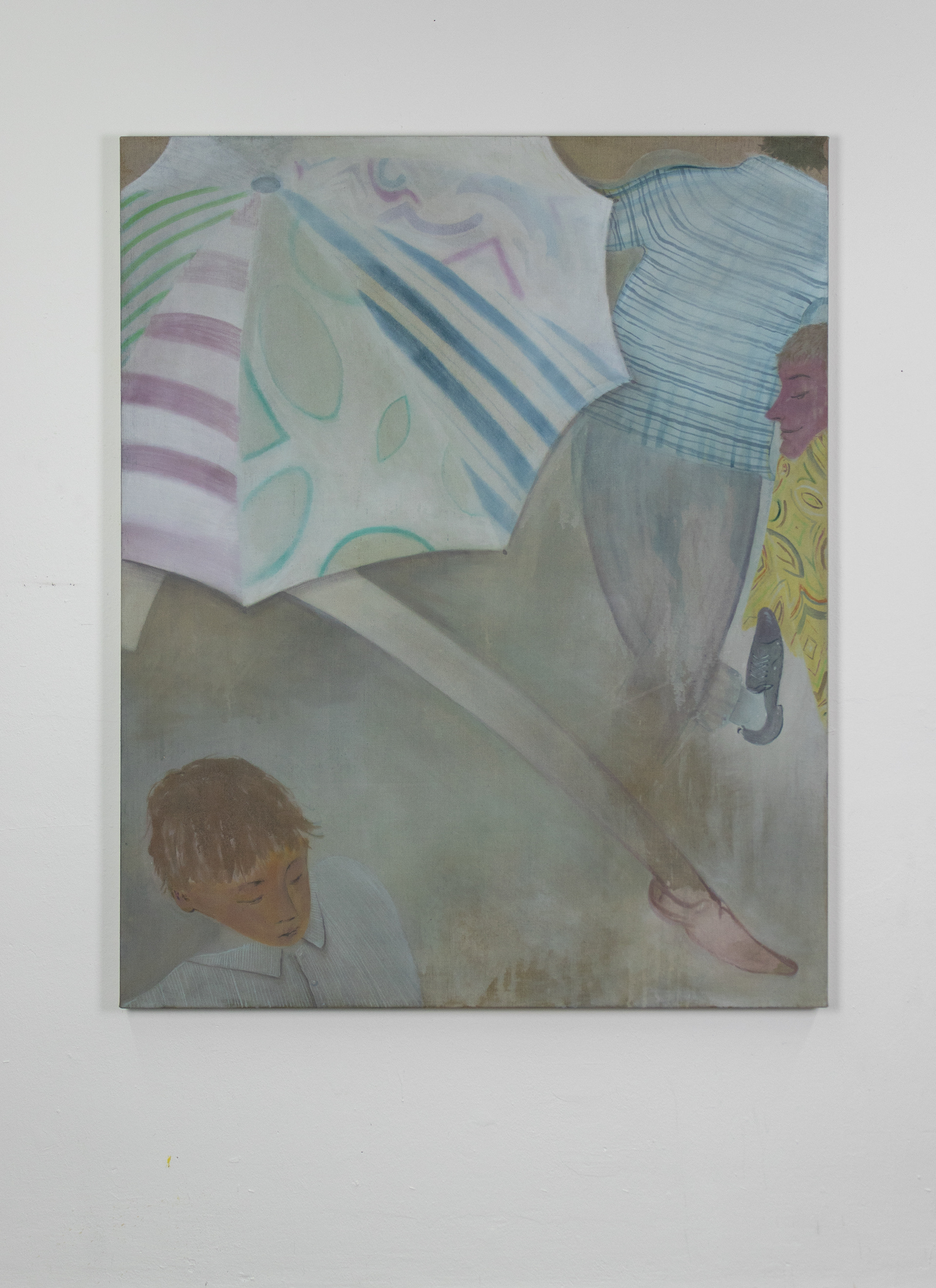
Bankasa, 2023, Oil on linen, 160 x 130 cm
E.M- Can you describe your usual artistic process for creating your paintings? Do you make sketches or preparatory works, or do you paint directly onto the canvas?
O.G- Most of the times I have a rough idea, a situation I want to show, or a specific perspective. Working these out in very quick and small drawings helps me to narrow down what works best. These are often just small thumbnails, laying out the basic forms. Then I just start working on the canvas, where everything else comes into place.
The process on canvas takes a long time, adding layers on layers. I’m often scared to take a big step and paint over something or to add contrasting colors. That’s why I use very thinned out paint, decide if it works and then need to do 20 layers more.
The process on canvas takes a long time, adding layers on layers. I’m often scared to take a big step and paint over something or to add contrasting colors. That’s why I use very thinned out paint, decide if it works and then need to do 20 layers more.
E.M- What are your main artistic influences on your work in general? And which artist do you most enjoy looking now?
O.G-There are a lot of influences, I have a folder on my phone with thousands of references I collected over the years. When I first started university, I was obsessed with Norbert Schwontkowski, I often went to the museum to see that one work they had of him. I guess you can also see the influence Kai Althoff has on me right now, both of them shaped my understanding of painting a lot.
As previously said, at the moment I’m also super interested in japanese wood cuts, especially the so called yokai, which are ghost and demon images. There is something weird but beautiful about them. Next to the collage-like forms and ornaments, it is the distorted faces that get me.
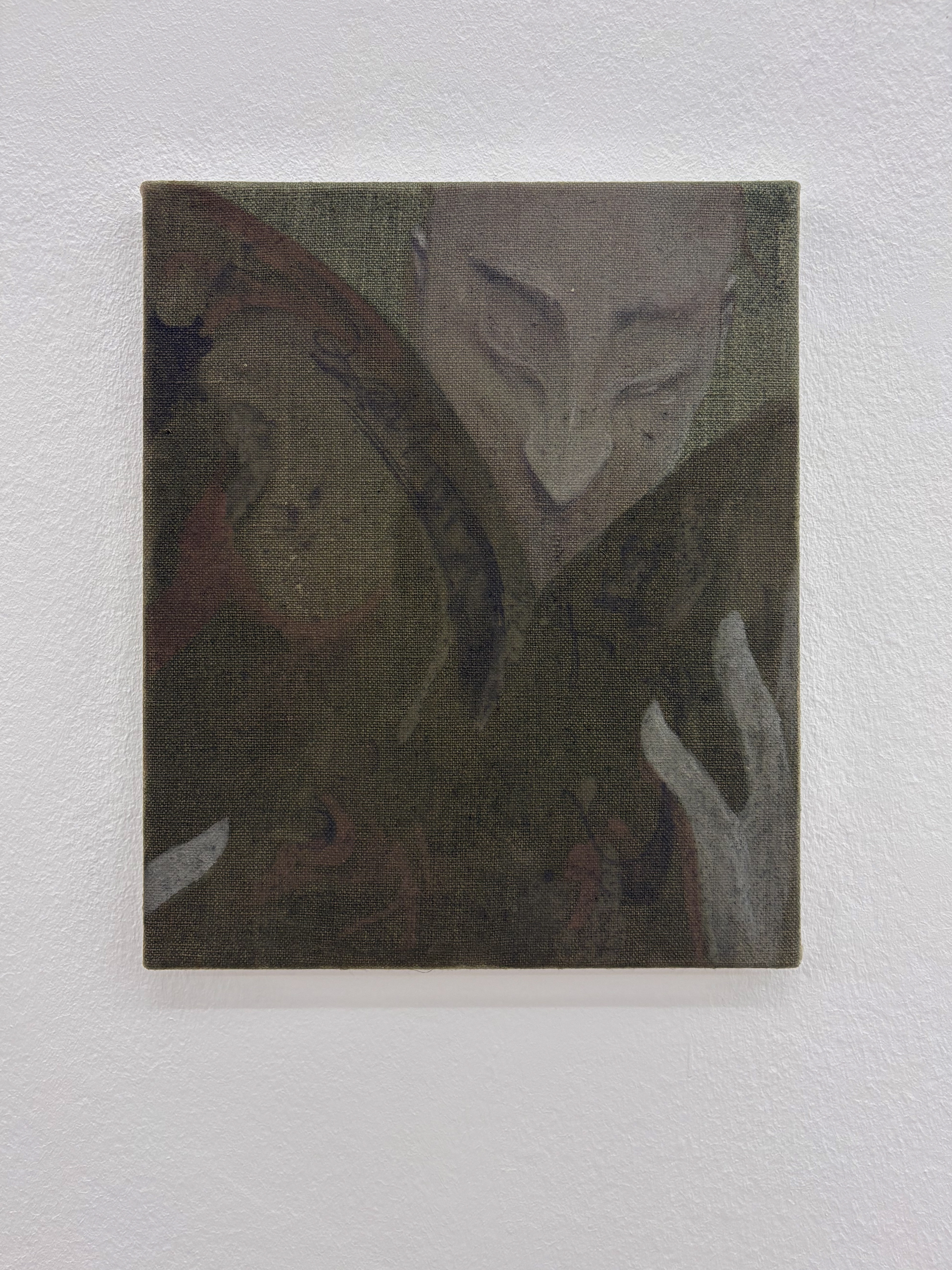
Untitled, 2025, Oil on linen, 25 x 30 cm