‘I like painting flowers - I have tried to paint many things in many different ways, but my paintbrush always gives a tremor of pleasure when I let it paint a flower - and I think I know why this is so. Flowers mean different things to different people - to some they are trophies to decor their dwellings (for this plastic flowers will do as well as real ones) - to some they are buttonholes for their conceit - to botanist they are species and tabulated categories - to bees of course they are honey - to me they are the secret of the cosmos.’
Winifred Nicholson - extrait tiré du livre d’Andrew Nicholson (1987) intitulé: Unknown Colour: Paintings, Letters, Writings by Winifred Nicholson
Winifred Nicholson - extrait tiré du livre d’Andrew Nicholson (1987) intitulé: Unknown Colour: Paintings, Letters, Writings by Winifred Nicholson
On the occasion of the exhibition ‘Cosmos’ bringing together, for the first time, the work of Italian painter Marta Ravasi and that of German painter Jörg Kratz, independent writer Eloïse Duguay conducted an interview with them and shares an exclusive conversation.
In this exchange, the painters discuss the representation of their motifs. They offer a sensitive approach to painting and explore the illusion of what is truly revealed on the seemingly flat surface of the painted object. Both artists bear witness to the infinite possibilities offered by the medium of painting, the endless exploration of a single subject, and the potential for renewal within it.

Marta Ravasi, Fiori, 2026, oil on canvas, 30 x 25 cm
"The illusion you get from the depiction of the space, in the end, is just pigments and tiny brushstrokes, something abstract."
Jörg Kratz
"Looking at a painting, falling into it, is like opening to another space. It is looking at an image but also at a handmade piece."
Marta Ravasi
Eloïse Duguay: Looking at your work, I’m diving into Jörg’s vast natural landscapes and Marta’s creamy bouquets that fill the canvas. I think of the dialogue between the infinitely large and the infinitely small, and their similarities. That’s what the title of this exhibition, ‘Cosmos’, inspires in me. How would you interpret it?
Jörg Kratz: I like to watch videos and lectures of physicists speaking about the universe, and one of them mentioned that there is this one aspect of the cosmos, which is infinitely large, that we are so tiny in something that might be infinite. But then, you have the microworld, which is probably even larger than we can imagine. So, our distance to the largest known objects is probably much smaller than the distance we have to the smallest known structures. This is a bit what we do in our personal painting practices, focusing on the infinitely small. When you zoom in on a flower, it opens up to a world that is very coherent, you can go into the depth of it. On my side, I look at spaces that you cannot actually grasp, but in a very small format. I also focus on the textures and on little details that in the end may be a reflection on our perception, on painting. Because the illusion you get from the depiction of the space, in the end, is just pigments and tiny brushstrokes, something abstract. This analogy might refer to the concept of the cosmos both in its largest connotation as well as in its smallest particles.
Marta Ravasi: My interpretation would be that it talks about the composition. Of a flower, of a bouquet, of a painting. It’s a dialogue which enlightens the fact that the more you look at the painting, the less you see the subject of the flower. I'm happy, when the view gets lost in this composition, those surfaces and textures. I'm looking at the simplest images that I have around me, and this choice is very peculiar in a way because I try to work on the simplicity of the shapes as well as the complexity of the surfaces, of the darker area, of the lighter area, of different grounds.

Jörg Kratz, in the riverbreeze a cluster of willowtrees, 2026, oil on canvas mounted on wood, 18 x 20 cm
E.D: For both of you, I sense a tactile approach in your painting. What does this tangible relationship with the surface mean to you?
M.R: I've been trying to overlap layers, while deleting the surface in some areas. Sometimes the brush is picking the surface and creating a sort of hole, so you can see what's behind it, the layer behind another one. It makes sense, because when we look at images, especially on the screen, we feel like they are flat surfaces. A painting is, in fact, a flat surface, but then it's not. The fact that one layer is overlapping to the other and that sometimes you see some sort of transparencies is interesting. It becomes both bidimensional and tridimensional. Looking at a painting, falling into it, is like opening to another space. It is looking at an image but also at a handmade piece. You can see where the brush has been, moving the material and if you zoom in, you can really see how the hand was moving. This duality of the surface which is flat but still is very much alive gives a very personal and close feeling that is very rare. It is something that I'm constantly looking at, not only when I look at my paintings, but also when I look at other artists’ work. I'm looking to see the way the material has been spread on the canvas.
J.K: I can very much relate to what you say, Marta, about this notion of a painting being a handmade object. Years ago I had a wonderful experience. I was at the Rijksmuseum in Amsterdam, and I was able to attend a special tour through the restoration studios. One of the major paintings was being restored, the Woman reading a letter (J. Vermeer, c. 1663). It was unframed, so you could see the edges of the canvas and how it was mounted on the stretcher. It was a wonderful experience to see how this magic of painting happens, when there is this transformation at the edges, right next to the flat surface of the canvas where the material turns into the illusion of a space in the painting. I always try to achieve that, as my paintings are built from monochromatic layers of color, which you sometimes see shining through. This is also why I leave my canvases unframed. Because then, you can see the marks of the loose brush as an expressive gesture or relief. Then, you have the reworked surface, a very thin texture that I hope creates some visual moment comparable to the sensation at the end of the day, when the light ceases and your eyes try to adapt to its lesser intensity.

In Marta Ravasi's studio, Milan, Italy
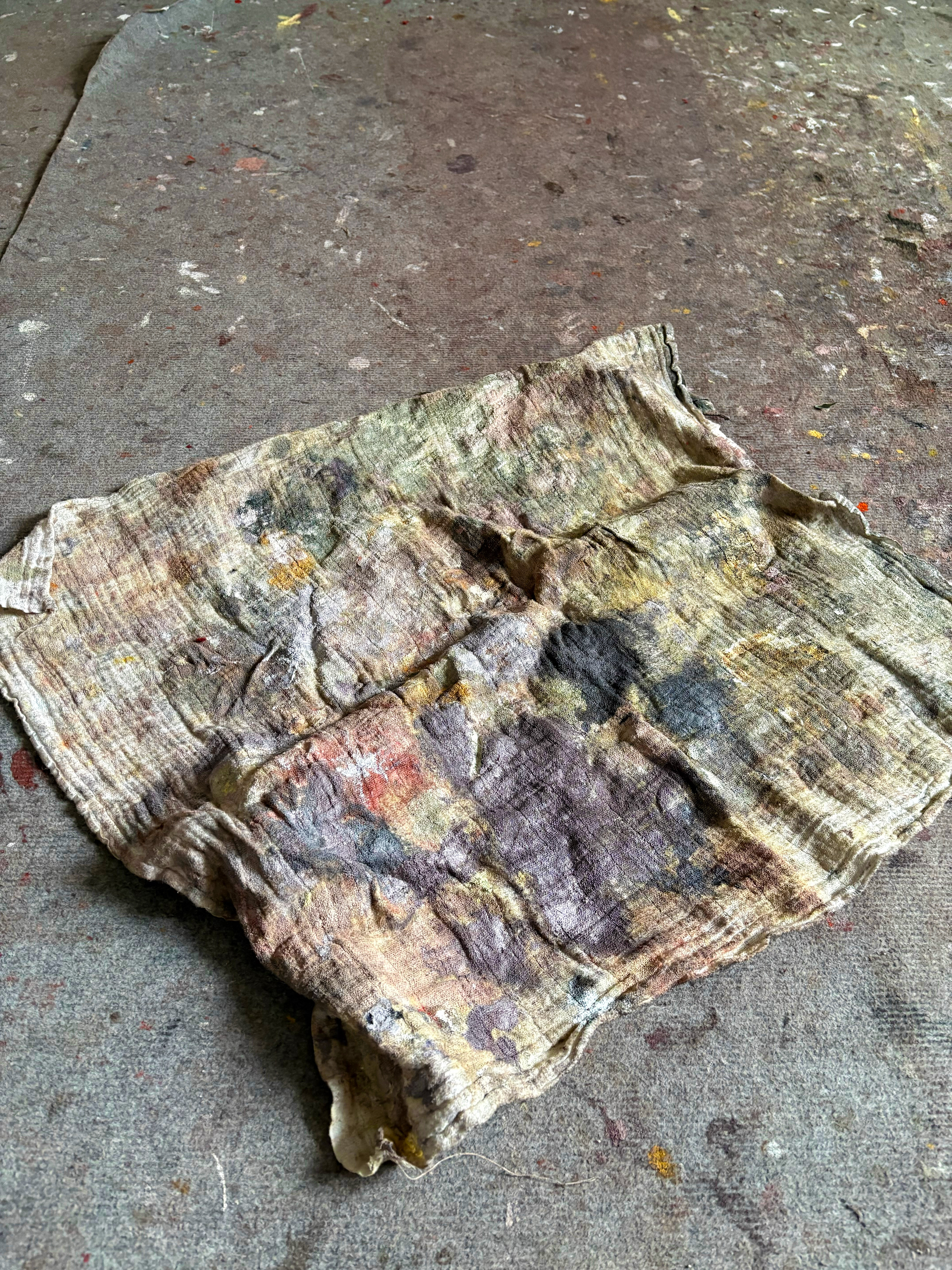
In Marta Ravasi's studio, Milan, Italy
E.D : I know that you, Marta, like to move your pieces inside your studio to study them under different lights or different moments of the day. Meanwhile, you, Jörg, play with the light, under the question of a moment, a time. Maybe this is why your subjects hover between a partial recognition of their motifs and the depiction of ethereal, elusive scenes.
M.R : It’s true, I'm always moving the painting around. I feel very vulnerable when I paint, because I don't start with an idea. I just start painting and make a big mess. But then, after hours of work and layers under the changing lights, after this path through which I reach the point where I decide that the painting is done, a feeling of acceptance sets in. It is rather a decision that I make than a goal I try to pursue.
J.K: In the studio, I apply four or five layers of paint to the canvas before I start with the actual motif. At a certain point, I must sense that the color that emerges from the layering is suitable. I do not always have an image in my mind, even if I have references that I use. I think I need to have the feeling that the organic combination of colors and brushstrokes must be coherent and satisfying for me to say, “Ok, now, I stop”. This can be a spontaneous decision, but it can also be something that I decide after looking at the painting for a few days or a week. If it proves to be not complete, I cover it with paint again and start anew.

In Jörg Kratz's studio, Haan, Germany
"The more you work on the same subject or the more you work in the same field, the more you know that there's still a lot to do and there's still a lot that you can discover."
Marta Ravasi
"My current exploration in this field of painting is still very fruitful for me, I feel there is much that I can still discover."
Jörg Kratz
E.D: It's very interesting, because your work offers, in its own unique way, a contemporary take on a traditional genre – landscape in one case, still life in the other, but you don’t seem to approach the canvas with the mindset that you are about to paint a landscape or a still life.
M.R: The first answer would be to say “Yes, I'm focusing on still lifes, I know what I'm doing and I prepare myself. I take some pictures of fruits and flowers.” The correct answer is that I'm doing it very instinctively. I'm happy to work with fruits and flowers because this choice reliefs me from choosing something else. Then, I'm not thinking too much about the subject or the composition of those fruits, I'm just thinking about painting. The choice of those subjects is the easiest one for me to not think about the object.
J.K: I never considered myself a landscape painter. I used to think that I was a painter of interior spaces, as someone who would continue the Dutch traditions of 17th century genre painting, focusing on people’s interiors as a reflection of their inner world. Six years ago, I noticed that I had driven this investigation of the interior to a point where I could not proceed. These were mostly architectural spaces, and I had reached a level of abstraction from which I didn't see a way to continue. Then I started experimenting with the application of color. And this appeared to look a bit like a landscape or a forest. I tried to focus on that motif, which allowed me to concentrate on what interests me most in painting: how a notion of spatiality emerges from pigments and from the way they are applied. I go out into landscapes often and I take pictures, but I'm most interested in the natural growth of forms, how trees grow, how branches grow. I do not really see them as trees or branches, but as an evolution of forms, as visual language. That’s what I try to recreate in a painting. For me, the landscape is the most non-confrontational motif I can work with. I don’t like confrontative motifs when painting. On the one hand, there is this control mechanism: the atmosphere needs to remind me of a landscape, but on the other hand, it's not that I clearly think about it consciously.

Marta Ravasi's palette

Jörg Kratz by Ibrahim Gonzalo
E.D: Would you like to share something else, one last thing?
M.R: In the future, I hope to get away from the still life at some point. I'm really interested in those subjects, but at the same time, I feel that, as I said before, they're just an occasion to be happy to paint. Who knows, I'm also curious about the future and its possible changes.
E.D: Wishing to start something different seems very hopeful.
J.K: The process of painting is so unforeseeable, it develops organically. The paintings I did in 2020 look different from what I do now, but I see an evolution in this work and it's something that interests me and with which I would like to continue. Maybe a new break will happen where I have the feeling that I have driven this current investigation to a point where I need to change the way I paint, or how I use my brushes. I try to think about painting figures, for example. I've tried in the past, but I noticed that I somehow cannot handle it. Maybe it would be interesting to do that, although it would not be coherent with the concept that I developed over the past years. I can only say that my current exploration in this field of painting is still very fruitful for me, I feel there is much that I can still discover.
M.R: Exactly, because the more you work on the same subject or the more you work in the same field, the more you know that there's still a lot to do and there's still a lot that you can discover. I feel that each painting is a step towards something else, but then I kind of keep going back to the initial subject. The more we go deep into something, the more the matter opens up, gets wider and wider.
J.K: Yes, that's perfectly true. I have worked a bit with film in the past years, which requires thinking in a very different pictorial way. But I always returned to painting. Because I somehow need to apply paint, and this constantly challenges me. I'm always unsure when I start. I often have long pauses between painting sessions, and I like that because the hand has unlearned some of its routine. And then you start a bit clumsy and you slowly get back into it, and the result is always different.

In Jörg Kratz's studio

In Jörg Kratz's studio, Haan, Germany
Jörg Kratz & Marta Ravasi
Cosmos
Exhibition from October 13 to October 31, 2026
Cosmos
Exhibition from October 13 to October 31, 2026
Galerie Elsa Meunier
15 rue Guénégaud 75006 Paris

Marta Ravasi (born in 1987, Italy) is an Italian painter based in Milan. Her paintings are regenerated landscapes that move with each stage of the day, even questioning the term “still life” that defines her subjects, so vital is the fresh thickness of her paint. The artist detaches herself from the principle of a realistic representation of her model to translate it, through a system of repetition and tactile exploration of the paint, into the very physicality of the pictorial material.
Marta Ravasi studied at the Brera Fine Arts Academy in Milan, the Hogeschool Sint Lukas in Brussels, and the Wimbledon College of Arts in London. Her paintings have been exhibited in group exhibitions in Italy, Brussels and London. And her work has been the subject of numerous solo exhibitions. Among them are the most recent ones, such as: ‘HEI-HO’, Acappella, Naples, Italy (2026) ; ‘LE ORE’, Galerie Falk Losniza, Basel, Switzerland (2026) ; ‘Focus on Marta Ravasi’, Workplace, London, United-Kingdom (2025) ; ‘Alla Prima’, La Centrale, Ruoms, France (2025) ; ‘Fresca’, Galerie Elsa Meunier, Paris, France ; ‘Marta Ravasi : Solo Geometry’, Painter Painting Paintings (online, 2024) ; ‘Marta Ravasi’, Diez Gallery, Amsterdam, Netherlands (2024). The artist presented also a solo exhibition at Arte Fiera art fair in Bologna with Acappella, Naples, Italy.

Jörg Kratz by Ibrahim Gonzalo
Jörg Kratz (born in 1987 in Haan, Germany) is a German painter based between Haan and Cologne. His works are characterised by such intense abstraction that references to the landscape only emerge in the suggestion of the verticality of a trunk or a horizon line. In his oils, the unevenly-spread colour reveals the rough support of the canvas glued to wood, and the planes are blurred to play with the depths that are revealed in transparency according to the light. In contrast to the frenetic pace of contemporary life, Jörg Kratz's enigmatic paintings invite the viewer to make a careful observation of fleeting appearances. The painter from the Rhineland does not seek simply to reproduce nature, but to capture its fleeting essence.
Graduated from the Kunstakademie of Münster in 2017 after studying philosophy and Art history at the University of Düsseldorf, the artist was also resident at the Cité internationale des arts in Paris in 2019. In 2026, ‘Là où l’eau rêve’ marked the artist's second solo exhibition with gallery Elsa Meunier. Jörg Kratz’s work is regularly featured in two-person and group exhibitions in Europe and abroad. Among the most recent are: ‘Neapolitan Sixth’, REGARD, Paris (2026) ; ‘Before the Mountain’, YveYANG Gallery, New York (2026) ; ‘TOBOGAN 02: Nothing Here Stays Still’, Reset Atelier, Bruxelles (2026) ; MATJÖ, Cologne (2025). ‘Spider Web Forest’, with Javkhlan Ariunbold, Conrads, Berlin, Allemagne (2024) ; ‘Bright Night’, with Dylan Williams, Galerie Elsa Meunier & Galerie Mathilde Le Coz, Paris, France (2024).